> For the complete documentation index, see [llms.txt](https://www.locksmith.guide/llms.txt). Markdown versions of documentation pages are available by appending `.md` to page URLs; this page is available as [Markdown](https://www.locksmith.guide/basics/compatibility.md).
# Compatibility with other apps and Shopify features
Locksmith works in and around the online storefront theme layer – an arena shared by many, many other apps. Locksmith's interoperability is excellent; its internal Liquid engine is very good at injecting its code in the right places, without causing issues for themes or apps. Because of this, **in the vast majority of cases, you won't need to worry about Locksmith's compatibility**.
Having said that, there are a few places where there are specific points of compatibility or incompatibility.
### Locksmith and the Shop App
We're pleased to announce that Locksmith is now compatible with the Shop app. Shopify has updated its policies to allow stores using Locksmith to remain eligible for the Shop app, provided all other Shop app eligibility requirements are met.
Shopify's policies prohibit the use of password control and age verification apps, such as Advanced Registration, B2B Login Access Management, Login to View Price, and MagicPass Wholesale, for stores wishing to use the Shop app. However, Locksmith is now explicitly listed as an exception to this rule.
When you use Locksmith to lock certain products, your store will still remain eligible to display on Shop, and your locked products will not be included in your Shop Store. This ensures that merchants can maintain the control Locksmith provides while remaining eligible for the Shop app.
{% hint style="info" %}
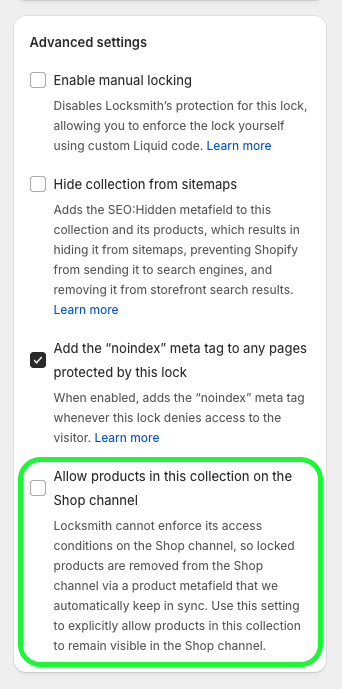
By default, Locksmith removes locked products and collections from the Shop channel using a product metafield.
If you want a locked product or collection to stay visible on the Shop channel, open the lock's **Advanced settings** and enable **Allow \[this product / products in this collection] on the Shop channel**.:
{% endhint %}
{% hint style="warning" %}
Locksmith can only manage visibility in the Shop app at the **product level**. Products locked by product and collection locks will automatically be removed from the Shop app. However, variants locked by variant locks will still be purchasable in the Shop app. It is therefore your responsibility to manage desired visibility for your variants in the Shop app.
{% endhint %}
For more details on Shop app eligibility requirements, including prohibited product types or other restrictions, please refer to Shopify's [Shop app eligibility requirements](https://help.shopify.com/en/manual/online-sales-channels/shop/eligibility/requirements).\
\
**Variant Locks and the Shop App**
Locksmith’s variant-level locks don’t automatically remove locked variants from the Shop app, as the app manages visibility at the product level. While Locksmith adds a metafield to exclude locked products or collections from the Shop app, Shopify doesn’t support sales channel visibility controls for individual variants.
If a product includes locked variants, the Shop app will flag it with a warning (“This product is hidden by a third-party app”) and prevent it from being listed.
**Workaround for Variant Visibility on the Shop App**\
To keep unlocked variants available while hiding locked ones, you can create duplicate products:
* One product with only unlocked variants, published to the Shop app.
* Another product with locked variants, excluded from the Shop app.
This solution offers greater control but may increase inventory management complexity. For guidance on using duplicate products, refer to our tutorial on [price tiers](https://www.locksmith.guide/tutorials/more/price-tiers#using-product-duplicates-1). You can also explore [inventory management tips](https://www.locksmith.guide/tutorials/more/price-tiers#inventory).
**Important: The Shop channel may be added to your store automatically**
Shopify automatically adds the Shop sales channel to any store that meets their Shop Merchant Guidelines — including stores that have Shopify Payments (or Shop Pay) enabled and a chargeback rate of less than 1% in the last six months. This means the Shop channel can appear in your Shopify admin without you installing it yourself, and your eligible products may become listed in the Shop app without any action on your part.
{% hint style="warning" %}
If you're using Locksmith to lock variants, be aware that the Shop channel being auto-added could expose those locked variants to purchases through the Shop app — since Locksmith's Shop app protection only works at the product level, not the variant level.
{% endhint %}
If you **don't** want your store or products listed on Shop, you have a few options:
* **Opt out of Sell with Shop:** In your Shopify admin, go to **Sales channels > Shop > Settings**, and change the **Sell with Shop** setting to "Link to online store" (this prevents direct purchases through Shop, though your products may still be discoverable).
* **Remove the Shop channel entirely:** In your Shopify admin, go to **Settings > Sales channels**, find Shop, and click **Uninstall**. Note that orders may still come through Shop even without the channel installed — see Shopify's documentation below for details.
* **Contact Shopify support** to request an account-level opt-out from the Shop App and/or Agentic Storefronts.
For full details on Shop eligibility and how auto-enrollment works, refer to Shopify's documentation:
* [Requirements for displaying your store in Shop](https://help.shopify.com/en/manual/online-sales-channels/shop/eligibility/requirements)
* [Setting up the Shop channel](https://help.shopify.com/en/manual/online-sales-channels/shop/setup)
* [Activating Shop Pay](https://help.shopify.com/en/manual/payments/shop-pay/activating-shop-pay)
## Officially unsupported apps
The following apps have known compatibility issues with Locksmith - although they *may* work in some cases, with the correct settings.
* Any other **access control apps** that work in a similar way to Locksmith will almost certainly not work well alongside Locksmith, as they tend to inject code into the same areas of your theme.
* [Bold Custom Pricing: Wholesale](https://apps.shopify.com/customer-pricing) - but only when using [Locksmith's variant locking ](/tutorials/more/locking-variants.md)and [manual locking](/tutorials/more/manual-mode.md) features.
* Any app that controls price at the variant level - but only when using [Locksmith's variant locking ](/tutorials/more/locking-variants.md)and [manual locking](/tutorials/more/manual-mode.md) features.
* Locksmith's [manual locking](/tutorials/more/manual-mode.md) feature, and many times full-page locks, can ***not*** generally be used to hide content being displayed by other third-party apps, including prices, buttons, widgets etc.
* [Gempages](https://apps.shopify.com/gempages) - while it is possible to use the apps together *in some cases*, there are still many compatibility issues between the two apps.
* [Weglot](https://apps.shopify.com/weglot) - Locksmith's [location detection key condition](/keys/visitor-location-keys.md) is not compatible with Weglot, but you should otherwise be fine using both apps at the same time if not using location detection.
## Other areas of incompatibility
* **Predictive searches** - Locksmith generally cannot remove products from searches that dynamically show search results as you type. This includes built-in theme searches, and most apps that add predictive searches to your theme. That being said, it is possible to manage the appearance of specific products in store searches using product metafields: [more information on that here](https://community.shopify.com/c/ecommerce-marketing/hiding-a-product-from-search-engine/td-p/484788).
* [The Checkout area](https://help.shopify.com/en/manual/checkout-settings) - Apps are heavily limited in their ability to change checkout, for security reasons. Locksmith cannot restrict shipping methods, shipping addresses, or most other checkout elements. However, you can [hide payment methods by customer tag](https://www.locksmith.guide/tutorials/more/hiding-payment-methods-by-customer-tag). If you need to restrict a customer's ability to check out,
you now have two options:
1. **Use Locksmith on the cart page**, before checkout begins. This is the traditional approach—more on that [here](https://www.locksmith.guide/tutorials/more/protecting-against-bots).
2. **Use our checkout validation feature**, which allows you to set up a single rule: products with a specific tag can only be purchased by customers who have a specific customer tag. This can help block unauthorized purchases—*without* modifying the checkout UI itself. Learn how to set that up [here](https://www.locksmith.guide/tutorials/more/setting-up-checkout-validation-with-locksmith).
* Protecting against bot/resellers - Locksmith can’t fully prevent purchases made by bots or resellers—especially when they’re using direct-to-checkout links, which bypass the Online Store entirely. Since Locksmith works within the Online Store channel, it can’t intervene at the checkout layer directly.\
\
However, we *do* now offer a **checkout validation** feature, which can help you block unwanted purchases **after** a customer reaches checkout. This is a powerful way to add another layer of control over who gets to buy what. Learn how to set it up here:\
[Setting up checkout validation with Locksmith](https://www.locksmith.guide/tutorials/more/setting-up-checkout-validation-with-locksmith)\
\
There are also other strategies you can use alongside Locksmith to reduce the risk of bot purchases. While these aren't built into Locksmith itself, we've outlined a helpful approach here:\
[Protecting against bots (without using Locksmith directly)](https://www.locksmith.guide/tutorials/more/protecting-against-bots)
* Locksmith cannot block RSS feeds from locked blogs.
* Locksmith can only hide products published to the **Online Store** sales channel, and absolutely cannot help with protecting, hiding, or restricting purchases on other channels.
* **Locksmith generally cannot hide elements or filter locked content in areas controlled by other third-party apps**, especially if those apps render their content outside the theme files where Locksmith injects its code.
* Locksmith is **not** compatible with [**headless or custom storefronts**](https://www.shopify.com/plus/solutions/headless-commerce) (e.g. sites built with Next.js, Hydrogen, custom frontend frameworks). Locksmith relies on Shopify's Liquid rendering engine and only works within the Online Store sales channel. In fully custom storefronts, there is no theme for Locksmith to work with, and no way for it to insert or enforce access logic.
---
# Agent Instructions
This documentation is published with GitBook. GitBook is the documentation platform designed so that both humans and AI agents can read, navigate, and reason over technical content effectively. Learn more at gitbook.com.
## Querying This Documentation
If you need additional information that is not directly available in this page, you can query the documentation dynamically by asking a question.
Perform an HTTP GET request on the current page URL with the `ask` query parameter, and the optional `goal` query parameter:
```
GET https://www.locksmith.guide/basics/compatibility.md?ask=&goal=
```
`ask` is the immediate question: it should be specific, self-contained, and written in natural language.
`goal` is optional and describes the broader end goal you are ultimately trying to accomplish on behalf of the user. GitBook uses it to tailor the answer towards what is most useful for that goal.
The response will contain a direct answer to the question and relevant excerpts and sources from the documentation.
Use this mechanism when the answer is not explicitly present in the current page, you need clarification or additional context, or you want to retrieve related documentation sections.