> For the complete documentation index, see [llms.txt](https://www.locksmith.guide/llms.txt). Markdown versions of documentation pages are available by appending `.md` to page URLs; this page is available as [Markdown](https://www.locksmith.guide/tutorials/more/klaviyo.md).
# Grow your subscriber lists with Klaviyo
Locksmith allows you to present your customers with a form to subscribe to a Klaviyo email list, which the customer must enter before they gain access to the locked content:
## Setup
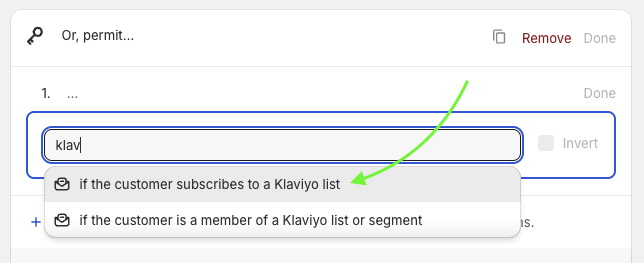
To get started, create a new lock or navigate to the lock you'd like to use, then add the key condition labelled "if the customer subscribes to a Klaviyo list".
You can optionally filter the list by typing "klaviyo" as the filter.
{% hint style="info" %}
You'll notice that Locksmith also supports *only* checking if a customer is already on a list (as opposed to subscribing them). This is a separate key condition, and it also supports checking segments! [We have a dedicated guide on that here](/tutorials/more/use-a-klaviyo-list-or-segment-as-an-access-control-list.md).
{% endhint %}
You'll need to create a Klaviyo API key and give it to Locksmith (see below). Once you do that, you'll be presented with your Klaviyo lists, and you'll be able to choose which one to use like so:
{% hint style="info" %}
As noted within the key condition setup, Klaviyo has their own policies regarding double opt in, and it is typically enabled by default. This setting is adjusted in your Klaviyo dashboard - it is not a setting that is controlled by Locksmith.
{% endhint %}
### Klaviyo API Access
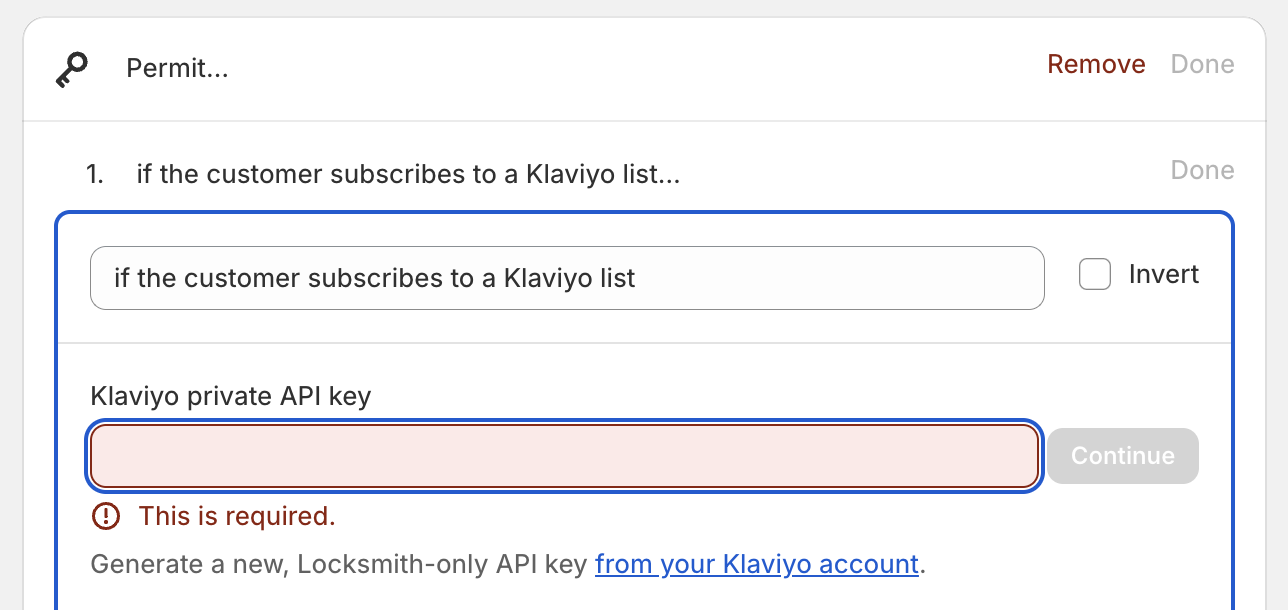
The first time you select this, Locksmith will prompt you for a Klaviyo API key:
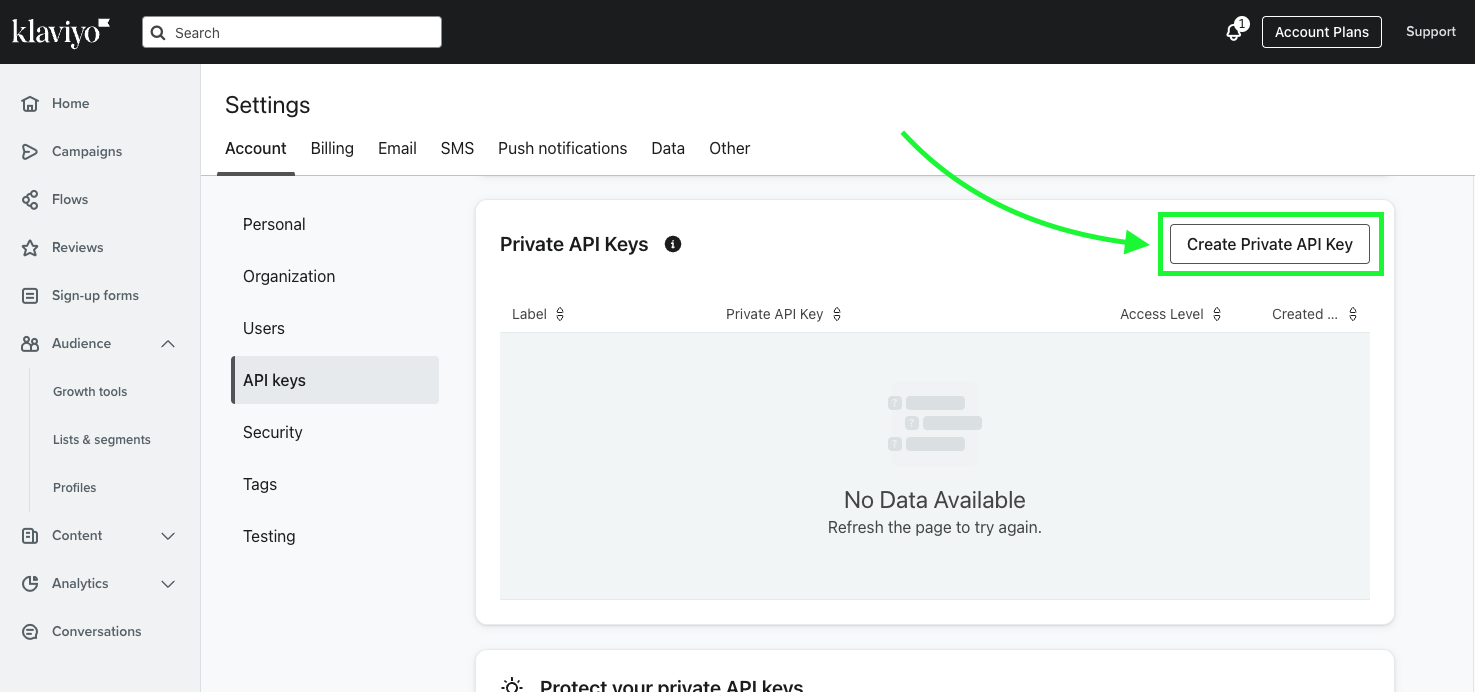
In your Klaviyo dashboard, go to Settings > Account > API Keys. You can also use the "from your Klaviyo account" link within Locksmith to go directly there:
Click the "Create Private API Key" button to create a key for Locksmith. You'll see the new key on the next screen.
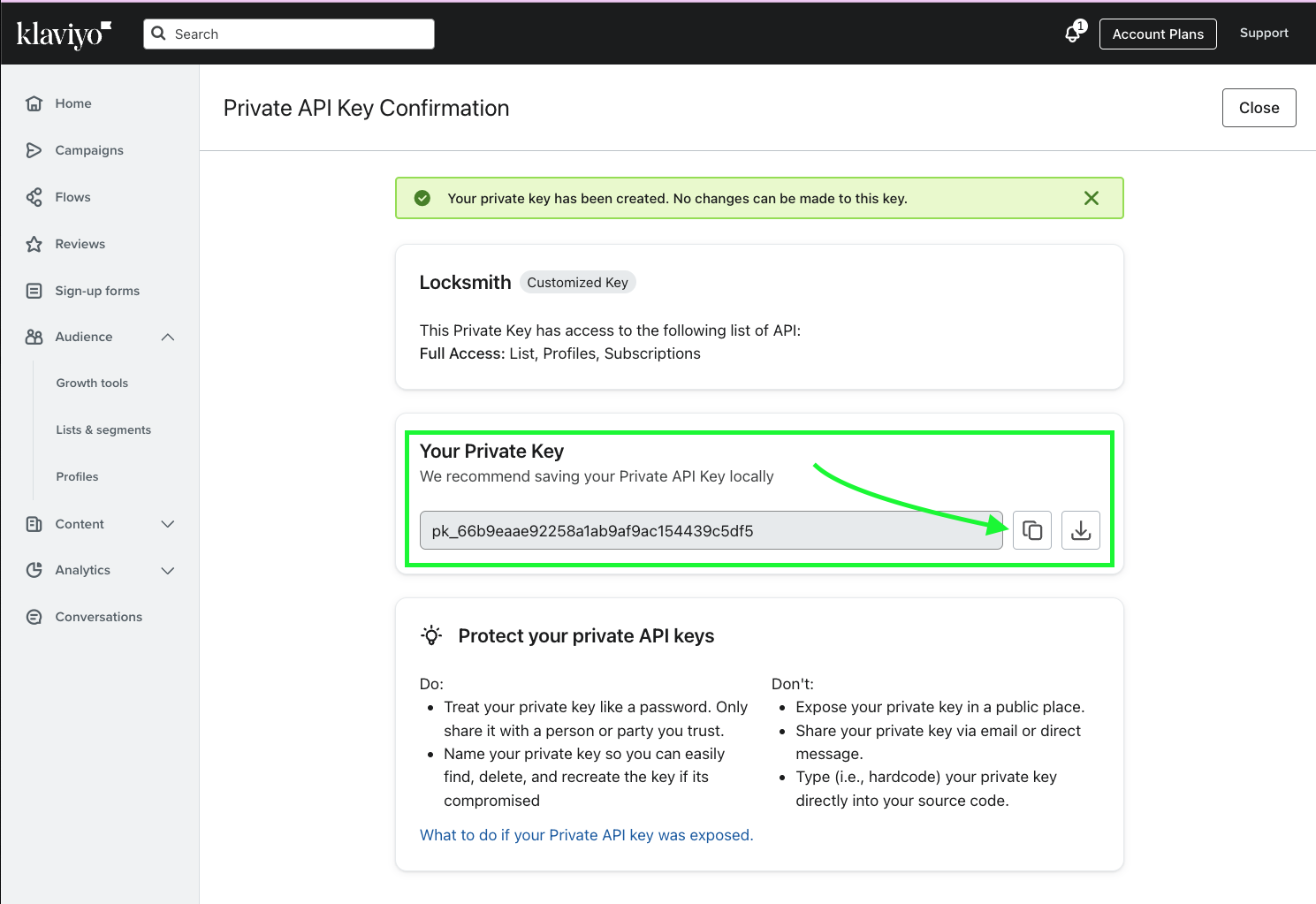
The scopes that Locksmith needs *full access* to from the Klaviyo API key are "List", "Profiles", "Segments", and "Subscriptions":
Copy the API key:
Then, head back to Locksmith, where you'll be able to paste in the key. Click "Continue", and Locksmith will present you with a list of Klaviyo lists, to which your new subscribers will be saved.
Once your Locksmith configuration is to your liking, hit the "Save" button. From here on out, new visitors to your locked resource will be required to subscribe before proceeding.
{% hint style="info" %}
**Note**: any customers who are already in your list will be seamlessly granted access when they enter their email address, and will not be added as a duplicate.
{% endhint %}
## Related articles:
{% content-ref url="/pages/9OqKmRBcX77ody3p6kr5" %}
[Customizing the email list signup form](/tutorials/more/customizing-the-email-list-signup-form.md)
{% endcontent-ref %}
{% content-ref url="/pages/77iwUv68N0neEBD4ZfM9" %}
[Use a Klaviyo list or segment as an access control list](/tutorials/more/use-a-klaviyo-list-or-segment-as-an-access-control-list.md)
{% endcontent-ref %}
{% content-ref url="/pages/eG56o6Uu6VtxcgDbdhwU" %}
[Newsletter keys](/keys/more/newsletter-keys.md)
{% endcontent-ref %}
---
# Agent Instructions
This documentation is published with GitBook. GitBook is the documentation platform designed so that both humans and AI agents can read, navigate, and reason over technical content effectively. Learn more at gitbook.com.
## Querying This Documentation
If you need additional information that is not directly available in this page, you can query the documentation dynamically by asking a question.
Perform an HTTP GET request on the current page URL with the `ask` query parameter, and the optional `goal` query parameter:
```
GET https://www.locksmith.guide/tutorials/more/klaviyo.md?ask=&goal=
```
`ask` is the immediate question: it should be specific, self-contained, and written in natural language.
`goal` is optional and describes the broader end goal you are ultimately trying to accomplish on behalf of the user. GitBook uses it to tailor the answer towards what is most useful for that goal.
The response will contain a direct answer to the question and relevant excerpts and sources from the documentation.
Use this mechanism when the answer is not explicitly present in the current page, you need clarification or additional context, or you want to retrieve related documentation sections.